
CVs are your first line of getting an employer’s attention. So it is extremely important that your CV does not end up to the side, forgotten. If you want to apply for a position, the first step is an effective CV that does not bore the reader within 10 seconds.
As part of the Science and Employability Skills module, apart from the blogs, we are also provided useful lectures and workshops by Christian Dun and Clare Brass that could help us after we graduate university such as writing CVs, preparing for an interview and even a practice session of teamwork and mock interviews.
Clare Brass, who works at Bangor University, has large amounts of experience concerning interviews, as she is involved in hiring processes within the university itself.
Clare has provided us a workshop on what makes a good CV
An effective CV has to contain important and relevant information tailored the position as well as conveying your personality in a way that is easy to read.
Relevance
Only include relevant information and don’t be afraid to remove some irelevent information. Employers only look for things they want. If you are applying for an ICT Job they won’t care about your GCSE Health and Social care qualification. Perhaps include your ICT Qualifications and experiences or even hobbies that involves computers.
Only if asked for list the relevant GCSE and A Levels Qualifications, as well as modules studied throughout your time at university which would be useful.
Layout
So the layout of the your CV is very important as it makes the document easy to read and understand as well as if it is done right it can give the impression of professionalism.
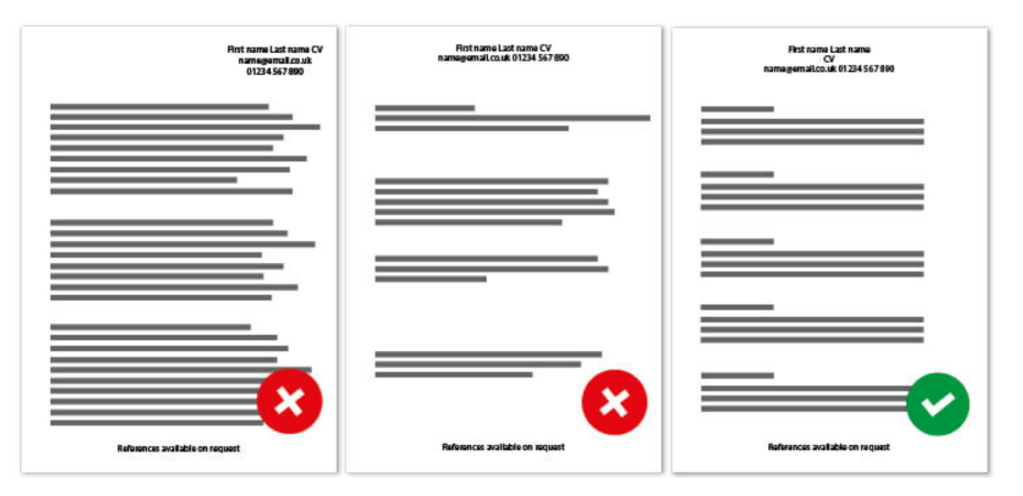
The ideal layout is short paragraphs but uniformly spaced throughout the page. This makes it easy to read and with each paragraph subtitled it means that it is easy to navigate. Important information should always be at the top, this could be your relevant qualifications and relevant employment history that could help you get the job.
Employers only have short periods of time to look at a CV. If they are difficult to read or look too cluttered you are less likely to be put in the forgotten pile.
Prove you’re human too
As they would have read down this section, means that they are interested and now is willing to spend more time to know more about you as a person. It’s important that your CV doesn’t just contain your academic achievements and grades.

You also need to write about your other achievements, qualifications, hobbies and interests.
You need to put across your personality so employers can see whether you’re well rounded person, or whether you’d be a good fit for the position.
The perfect CV includes
- Relevant grades
- Relevant modules
- Personal profile
- Employment history
- Relevant skills/qualifications
- Simple layout with a flow
- Extracurricular activities/hobbies/interests
The finishing touch
Before you send your CV to the position you are applying for. Other than proof reading for grammar and spelling. It is important that the CV is tailored and focused exactly to that job by looking at the job decription.
Making these small changes in detail makes a big difference of the effectiveness of your CV:
- Change the way you word your sentences to pick up on key words based on the Job description. If the job description requires confidence instead of saying “I worked in a lab” you could say “I worked in a ISO Class 3 lab” this addition of information and gives more evidence for you being confident but also shows you are knowledgable.
- Change you skills to suit the job so if they job requires aseptic technique make sure you put emphasis aseptic practices in your skills section.
Reflection
Initially thinking that I had a perfect CV alrady, this workshop by Clare Brass has helped me significantly in tweaking my own CV by cutting down irrelevant Information and rearranging the layout of my document by having the most important points at the top of the page.
In the future when I apply for a job I will look at the job description and ensure that my CV is tailored to that specific job by only including specific information that will help me in the work place of the job I’m applying for. Including only relevent qualifications, skills and hobbies.
 The Curious Biologist