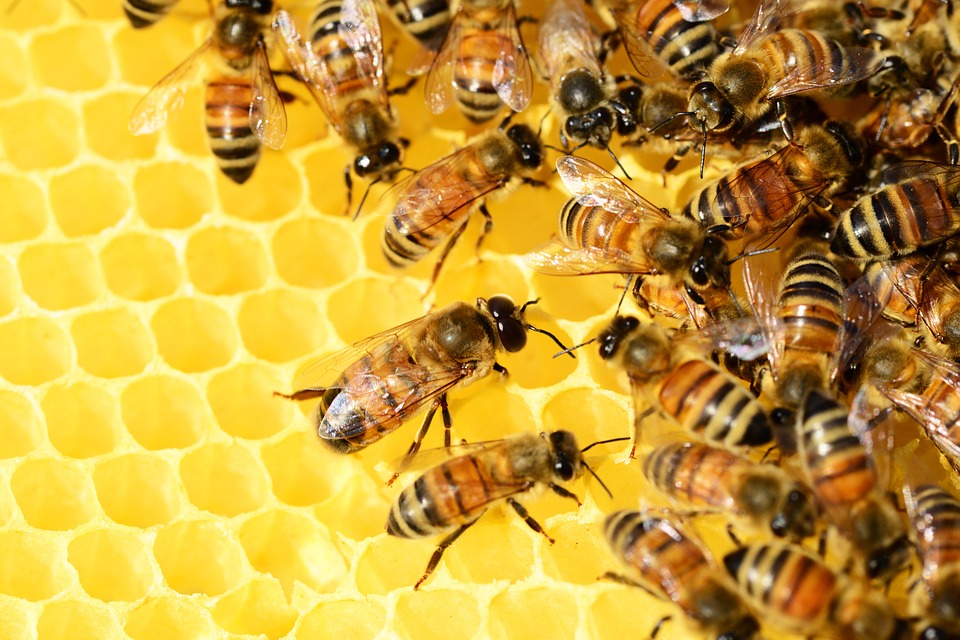
Bees have seen to be declining in population since the early 1990 and its hasn’t gone back up ever since. We take them for granted people need to understand their importance in this planet and that their extinction would be as catastrophic as that of climate change. I was very impressed when both Bangor university students and the local community was present in this lecture, it’s a great way of spreading awareness and education to a wider audience.
Bees are responsible for the 1/3 of the food we eat and many other plants such as flower plants rely upon them for pollination. They are vital for the sustainability of the world’s agriculture, environment and economy.
When bees become extinct It will also trigger the extinction of many plants and animals including ourselves. However, before that happens war and conflict will arise as people would be fighting for food due to the decline plant-based food and the death of live stocks.
No more bees, no more pollination, no more plants, no more animals, no more man.
Albert Einstein
Why are the bees dying?
- Parasites like Acarapis woodi, mites that infect the bees by laying their eggs inside the trachea and feed from their liquids weakening the bees until death.
- Another parasite Varroa destructor, parasites that can only reproduce in bee hives feeding upon their lave
- Bees Loosing Habitats, this is mainly due to the
- Pesticide poisoning through exposure to pesticides applied to crops or for in-hive insect or mite control.
- Stress bees experience due to management practices such as transportation to multiple locations across the country for providing pollination services.
- As climate change is already bad enough, climate change preventing their mating and pollination by strong winds will only accelerate our decline to extinction.
All these factors could be the cause of CCD (Colony Collapse Disorder)
Things being done to prevent CCD
- According to the US Department of Agriculture CCD Action plan, survey and data collection will be further analysed to identify the extent of CCD
- Analysis of Bee Samples to determine the prevalence of various pests and pathogens, bee immunity and stress, and exposure to pesticides.
- Hypothesis-Driven Research on four candidate factors such as new and remerging pathogens, bee pests, environmental and nutritional stresses, and pesticides.
- Mitigative/Preventive Measures to improve bee health and habitat and to counter mortality factors.
At this time of writing there is no certain evidence of what is causing CCD however is it good to see that there is something being done about it. Although I do believe that there should be more awareness that is put towards it as much as that of climate change. As both issues are equally dangerous for the planet.
Reflection
Found this very interesting due to the fact it’s a global crisis that not much people know about which could be due to the lack of publicity. In the future if the population of bees continues to fall and climate change arise. I will support the movement that aids these catastrophic crisis. By working for an organisation such as that of “United Nations Environment” as a Infographic and Documentary design”. Here I could use my knowledge in creating media and my background in science to work for a non profit organisation that not only spreads awareness but also make a difference. This will be a great opportunity for me to work temporarily abroad.
 The Curious Biologist